How AI is Driving Digital Transformation Across Industries

Introduction

AI is at the core of digital transformation, reshaping industries by automating operations, enhancing customer experiences, and enabling data-driven decision-making. Businesses that embrace AI-driven transformation are achieving faster innovation, greater efficiency, and a competitive edge in their respective markets.

In 2025, organizations that fail to integrate AI into their digital strategies will struggle to keep up with competitors who are leveraging AI to optimize workflows, personalize services, and streamline decision-making. AI is no longer just an enabler—it is the driving force behind the future of business transformation.

How AI is Transforming Industries

AI in Healthcare: Enhancing Patient Care and Diagnostics

AI-powered diagnostics, predictive analytics, and robotic process automation are improving patient outcomes. AI assists doctors in detecting diseases early, personalizing treatments, and optimizing hospital operations.

AI in Finance: Risk Management and Fraud Detection

Financial institutions are using AI to detect fraudulent transactions, optimize credit risk assessment, and automate compliance processes. AI enhances decision-making by analyzing financial data and predicting market trends.

AI in Retail: Personalized Shopping and Inventory Management

AI enables retailers to offer personalized recommendations, predict demand, and optimize inventory levels. AI-powered chatbots enhance customer engagement, while computer vision improves in-store experiences.

AI in Manufacturing: Smart Factories and Predictive Maintenance

AI-driven automation and IoT-powered predictive maintenance are reducing downtime and improving production efficiency. Manufacturers use AI to detect defects, optimize supply chains, and enhance operational safety.

Key Benefits of AI in Digital Transformation

Faster Innovation and Agility

AI accelerates product development, streamlines operations, and enables businesses to adapt quickly to changing market demands.

Improved Customer Experience

AI-driven chatbots, personalized recommendations, and predictive analytics enhance customer interactions and satisfaction.

Operational Efficiency and Cost Reduction

AI-powered automation reduces human intervention, lowers operational costs, and improves overall business efficiency.

Enhanced Data-Driven Decision-Making

AI analyzes vast amounts of data in real time, providing business leaders with actionable insights for strategic decision-making.

How Enterprises Can Implement AI in Digital Transformation

Identify AI Opportunities Across Business Functions

Enterprises should assess where AI can drive the most value, such as customer service automation, supply chain optimization, or risk management.

Deploy AI-Powered Analytics and Automation

Organizations should integrate AI-driven analytics tools, machine learning models, and automation platforms to streamline operations.

Modernize IT Infrastructure with AI and Cloud

AI adoption requires cloud-based infrastructure and scalable data processing capabilities. Businesses must invest in AI-friendly IT ecosystems.

Train Employees for an AI-Enabled Workforce

Successful digital transformation requires upskilling employees and creating a culture that embraces AI-driven innovation.

Challenges in AI-Powered Digital Transformation

AI Integration with Legacy Systems

Many enterprises rely on outdated IT systems that are not AI-compatible. A phased AI adoption approach ensures smooth integration.

Data Privacy and Security Concerns

AI-powered systems must comply with data protection regulations and ensure secure handling of sensitive business data.

Change Management and AI Adoption

Employees may resist AI-driven transformation. Organizations must prioritize training and change management initiatives.

The Future of AI-Driven Digital Transformation

AI is redefining digital transformation by enabling businesses to operate more efficiently, innovate faster, and improve customer experiences. Organizations that integrate AI-driven automation, predictive analytics, and intelligent decision-making will lead the next wave of digital transformation.

The future belongs to enterprises that embrace AI as a strategic enabler. The question is not whether to integrate AI—but how quickly businesses can adopt AI-powered solutions to stay ahead in a rapidly evolving digital landscape.

How Enterprises Can Build an AI-Powered Digital Transformation Roadmap

Introduction

Digital transformation is no longer about migrating to the cloud or modernizing IT infrastructure—it’s about leveraging AI to drive business growth, improve decision-making, and automate complex processes. In 2025, enterprises that fail to adopt AI-driven transformation strategies risk becoming obsolete.

AI isn’t just a tool; it’s a strategic enabler that redefines how businesses operate. But integrating AI into an enterprise requires a structured approach, clear objectives, and the right technology stack.

Why AI is the Key to Digital Transformation

Enhancing Decision-Making with AI

AI enables enterprises to analyze vast datasets in real time, uncover patterns, and generate actionable insights. From predictive analytics to AI-driven forecasting, enterprises can make smarter, data-backed decisions faster than ever.

AI-Driven Automation & Efficiency

Enterprises can streamline workflows and eliminate repetitive tasks with AI-powered automation. From HR and finance to customer service and supply chain management, AI is driving efficiency across business functions.

Customer Experience Transformation

AI-driven chatbots, recommendation engines, and hyper-personalized experiences are changing how businesses interact with customers. Enterprises that leverage AI for customer engagement see higher retention and satisfaction rates.

The AI-Powered Digital Transformation Roadmap

Step 1: Define AI Objectives & Business Goals

Before implementing AI, enterprises must identify specific goals: Is the goal to improve operational efficiency? Enhance customer experiences? Reduce costs? Clear objectives ensure a well-structured AI adoption strategy.

Step 2: Assess AI Readiness & Data Maturity

AI relies on high-quality data. Enterprises need to evaluate their existing data infrastructure, governance policies, and integration capabilities before implementing AI solutions.

Step 3: Choose the Right AI Technologies

From machine learning and deep learning to natural language processing and AI-powered automation, enterprises must select the right AI tools tailored to their needs.

Step 4: Start with AI Pilots & Scale Gradually

Successful digital transformation doesn’t happen overnight. Enterprises should start with pilot AI projects, test the impact, and then scale solutions across the organization.

Step 5: Integrate AI with Existing Systems

AI must seamlessly integrate with existing enterprise systems, including CRM, ERP, and cloud infrastructure. This requires API-driven architecture and cloud-native solutions.

Step 6: Train Employees & Build an AI-First Culture

AI adoption is not just a technology shift—it’s a cultural shift. Enterprises must invest in AI training programs and encourage employees to embrace AI-driven workflows.

Step 7: Continuously Monitor & Optimize AI Models

AI models need continuous improvement. Enterprises must establish AI governance policies, monitor model performance, and optimize algorithms regularly to ensure accuracy and relevance.

Challenges in AI-Powered Digital Transformation

Resistance to AI Adoption

Employees and leadership teams may resist AI-driven changes. Clear communication and training programs are key to successful adoption.

Data Privacy & Security Concerns

Enterprises handling sensitive customer data must comply with global data privacy regulations and ensure AI models do not introduce security vulnerabilities.

Managing AI Bias & Ethics

AI models can inherit biases from historical data. Enterprises must ensure AI systems are transparent, fair, and ethically aligned with business values.

The Future is AI-Driven

AI-powered digital transformation is not an option—it’s a necessity. Enterprises that build structured AI roadmaps will experience higher efficiency, faster innovation, and better customer engagement.

The key to success is not just implementing AI, but integrating it seamlessly into business operations. Enterprises that embrace AI now will lead their industries in 2025 and beyond. The question isn’t whether AI should be adopted—it’s how fast enterprises can transform to stay ahead of the competition.

Enterprise Application Integration- A comprehensive guide

Quick Summary

In today’s digital world, businesses rely on many applications and systems to handle essential functions. Integrating these various systems helps improve efficiency but creates a big challenge. When data and workflows are isolated in different systems, it can block the flow of information, reduce visibility, and make the organization less agile.

Enterprise Application Integration (EAI) addresses these issues by connecting different systems and enabling smooth data exchange across the organization.

According to an ESG report, 83% of organizations consider enterprise integration a top-5 business priority.

The blog dives into the importance of EAI in creating efficient business operations and maintaining a competitive edge.

What is Application Integration?

Application integration connects different software applications to work together and share information in real time. This can be done whether the applications are on-site, in the cloud, or at the edge. By linking these systems, businesses can remove obstacles between older on-site systems and new cloud applications. This connection of processes and data makes operations more efficient and allows businesses to work in new and innovative ways.

Why is Enterprise Application Integration Important?

Enterprise Application Integration (EAI) eliminates Data Silos as it connects various systems. It prevents data from being stuck in separate places. Thus, making it easier for teams to collaborate and get a unified view of data, improving its quality.

Other benefits include: 

  1. Streamlines Workflows: EAI makes workflows smoother by automating processes and boosting efficiency. This reduces errors and speeds up tasks, helping operations run more smoothly.
  2. Enhances Customer Experience: EAI ensures that customers receive timely and accurate information, improving their experience with the business.
  3. Reduces Costs: By eliminating manual processes, EAI reduces costs and boosts overall productivity.
  4. Competitive Advantage: Companies with effective EAI can quickly respond to market changes and integrate old systems with new ones, staying ahead in the competitive landscape.
  5. Better Customer Insight: EAI allows businesses to gather and interpret customer information from various sources in one place, giving a complete view of their customers and ensuring compliance with privacy regulations.
  6. Future-Proofs IT Systems: EAI connects old legacy systems with new cloud technologies, allowing businesses to access real-time data and support new business models while modernizing their IT infrastructure.

Use Cases of Enterprise Application Integration

Enterprise Application Integration (EAI) simplifies complex digital systems and boosts business agility by connecting different tools and systems. Here are some examples:

  1. Order Processing: EAI can link e-commerce, inventory, and CRM platforms. When a customer places an order, the system automatically updates stock levels, sends order details to the dispatch center, and notifies customers throughout the process.
  2. Marketing Automation: EAI can connect various marketing services into a single hub. This integration ensures data availability and efficiency by combining creative and financial aspects of marketing. Additionally, it automates payments for marketing services and transfers invoices directly to financial records.
  3. Project Management: EAI tools allow you to schedule projects, assign tasks, track progress, and manage financial reporting all in one place.

Key Considerations in Enterprise Application Integration

To successfully implement enterprise integration, follow these best practices:

  1. Adopt a Platform Approach: Use a platform-based strategy to support various integrations, such as applications, processes, data, and sensors. This approach works across on-premise, cloud, and hybrid environments.
  2. Use APIs as Building Blocks: APIs are essential for integration, acting as interchangeable components. They help connect people, processes, and systems, making creating new business models easier and monetizing digital assets.
  3. Make Integration Accessible to Everyone: Allow all users, regardless of technical skill, to build and update integrations with easy, no-code tools. This will reduce dependence on developers and maximize business value.
  4. Implement Smart Lifecycle Management: Develop plans to manage integrations over time. These plans should include access control, change management, integration extension rules, system credential management, and data encryption. For hybrid setups, ensure lifecycle management can apply updates and patches on-premise and in the cloud.
  5. Use Analytics and Predictive Intelligence: Analyze integration activities to gain insights into data flow across the organization. Predictive intelligence can identify usage patterns and improve integrations based on these insights.
  6. Security: Implement strong security measures like authentication and authorization to ensure only authorized users can access data. Use data encryption both when it’s stored and when it’s being transferred to meet regulatory standards.
  7. Scalability: The system should handle increasing data and transactions without slowing down. Plan for scalability by allowing the system to add more servers (horizontal scaling) or upgrade existing ones (vertical scaling). Cloud-based solutions can adjust resources automatically based on demand.
  8. Usability: Make the system easy for business users, IT staff, and developers. Provide a user-friendly interface, clear APIs, detailed documentation, and useful development tools. Offer training and support to help users make the most of the integrated applications.
  9. Complexity: Simplify the system using good design practices like modularity and loose coupling. Use middle-layer components like API gateways to create consistent and predictable interactions between different systems. This reduces the complexity of integrating diverse business applications and data formats.

Choosing the Right Integration Architecture

EAI programs involve significant technology investments. Selecting the appropriate integration architecture is critical to maximize value and minimize the total cost of ownership. Here are the key options:

Point-to-Point Integration: This method connects applications directly rather than through an intermediary. It offers simplicity up front but does not scale well as integration needs to grow in complexity and volume. Managing all interconnected links also grows cumbersome.

  • Ideal For: Small-scale, tactical application integration.

Hub-and-Spoke Integration: Applications connect via a central integration hub that handles routing and coordination. While more advanced than point-to-point, it can still suffer performance issues as throughput rises.

  • Ideal For: Departmental application integration.

Message Bus Integration: A message bus allows applications to communicate via events, queues, and streams asynchronously. This supports high-volume, real-time integration demands with built-in scalability.

  • Ideal For: Enterprise-wide integration spanning mission-critical applications.

Hybrid Integration: A hybrid model combining point-to-point, hub-and-spoke, and message bus can provide ultimate flexibility as needs evolve. However, it also increases complexity.

  • Ideal For: Complex enterprise application portfolios.

While the emergence of the message bus has fueled growth in cloud integration platforms, organizations also continue to use on-premise hubs and ESBs based on workloads and security considerations.

Conclusion

As companies strive to optimize performance, integrated IT systems are the catalyst. Breaking down decades-old applications and data silos unlocks immense potential for growth and efficiency.

Enterprise Application Integration (EAI) evolves from a one-time project into an adaptive digital platform continuously enhancing business operations.

While the journey to seamless integration may have challenges, the result is a future-ready enterprise poised to excel in the digital era.

At UpsquareCS, our certified integration experts can help you bridge systems and unlock your digital potential effectively. We ensure your enterprise thrives in the fast-paced digital world.

Streamline Business Workflows With RPA Automation

Quick Summary

Businesses constantly seek innovative solutions to streamline operations and maximize efficiency. Robotic Process Automation (RPA) promises to revolutionize how businesses automate repetitive tasks.

RPA offers a unique approach to automation by leveraging software robots to perform mundane and time-consuming tasks, allowing employees to focus on more strategic initiatives. From data entry and document processing to customer support and invoice management, RPA can potentially transform virtually every aspect of your business workflow.

The blog discusses how RPA can help businesses to automate and optimize their business processes.

Understanding How Workflow Automation Works

Step 1: Identifying Repetitive and Manual Tasks

Workflow automation begins with identifying repetitive, time-consuming, and error-prone tasks.

Step 2: Designing and Mapping Workflows

Organizations design and map workflows with identified tasks, establishing a clear sequence of actions, rules, and decision points. This process lays the groundwork for smooth and efficient automation.

Step 3: Implementing Workflow Automation Software

The next step is selecting and deploying workflow automation software tailored to specific organizational needs. These software solutions provide the tools and functionalities to automate and oversee workflows seamlessly.

Step 4: Training Employees and Managing Change

Successfully adopting workflow automation hinges on properly training employees on new processes and nurturing a culture conducive to change.

Benefits of RPA

1. Time Savings

RPA streamlines repetitive administrative tasks, allowing employees to focus on strategic endeavors and boosting overall productivity.

2. Increased ROI

By enhancing work productivity and collecting valuable data over time, RPA positively impacts Return on Investment (ROI), improving several business processes and cost management strategies.

3. Error Elimination

Automated bots in RPA systems ensure tasks are executed accurately every time, eliminating the potential for human error and fatigue.

4. Enhanced Security

RPA reduces human interaction with sensitive data, bolstering cybersecurity measures and safeguarding against data breaches and leaks.

5. Improved Compliance

RPA precisely adheres to industry and government regulations, minimizing compliance risks and offering consistent auditability.

6. Scalability

As RPA tools automate more tasks across the organization, businesses can scale operations to meet demand fluctuations and confidently achieve targets.

7. Employee Satisfaction

By automating tedious tasks, RPA frees employees to focus on more meaningful work, increasing job satisfaction and enabling them to apply their skills to strategic initiatives.

Incorporating RPA into business processes empowers organizations to optimize efficiency, reduce errors, and unlock the full potential of their workforce.

Automate Your Business Workflows With RPA

RPA (Robotic Process Automation) automates repetitive, rule-based tasks traditionally performed by humans. It improves efficiency, ensures compliance, and empowers employees to focus on strategic initiatives.

1. Task Automation: RPA bots mimic human actions to automate routine tasks across various applications and systems. This includes data entry, form filling, report generation, and more.

2. Integration Capabilities: RPA tools can seamlessly integrate with existing systems and applications, allowing for end-to-end automation of workflows spanning multiple departments and processes.

3. Efficiency Improvement: By completing tasks with speed and accuracy 24/7, RPA enhances operational efficiency, reduces processing times, and minimizes errors, leading to cost savings and improved productivity.

4. Scalability: RPA solutions can scale up or down based on business needs, accommodating fluctuations in workload and ensuring consistent performance even during peak periods.

5. Compliance and Auditability: RPA ensures adherence to regulatory requirements and internal policies by executing processes consistently and maintaining detailed audit logs for compliance purposes.

6. Enhanced Decision Making: By automating repetitive tasks, RPA frees up human resources to focus on value-added activities such as analysis, strategic planning, and decision-making, driving innovation and business growth.

Where can RPA be used?

RPA (Robotic Process Automation) finds application across diverse industries and processes, driving efficiencies and relieving individuals from repetitive tasks. From financial services to healthcare, manufacturing to retail, and beyond, enterprises deploy RPA across various functions, including finance, compliance, legal, customer service, operations, and IT.

The versatility of RPA lies in its broad applicability. Any high-volume, rule-based, repetitive process is ripe for automation, and increasingly, cognitive processes demanding advanced AI capabilities are also candidates for RPA implementation.

Top RPA Platforms

1. UiPath

UiPath is a leading RPA platform known for its user-friendly interface and automation capabilities. It offers a range of features, including process recording, development, and management tools, making it suitable for businesses of all sizes. UiPath’s drag-and-drop interface allows users to automate tasks quickly and efficiently, while its AI capabilities enable advanced automation of complex processes.

2. Automation Anywhere

Automation Anywhere provides both attended and unattended automation, leveraging AI and machine learning for complex process automation. This enables businesses to streamline workflows and enhance productivity.

3. Blue Prism

Blue Prism is a trusted RPA platform known for its scalability and security features. It offers a centralized platform for automating and managing business processes, making it suitable for large enterprises with complex automation requirements.

4. Microsoft Power Automate

Microsoft Power Automate is a cloud-based automation platform that integrates with Microsoft’s suite of productivity tools, such as Office 365 and Dynamics 365. It offers a wide range of pre-built connectors and templates, allowing businesses to automate workflows across various Microsoft and third-party applications. With Power Automate, users can create automated workflows using a simple, no-code approach, making it accessible to users with varying technical expertise.

Conclusion

Embracing Robotic Process Automation (RPA) offers businesses a powerful solution to automate and streamline workflows across various functions and industries. By leveraging RPA technologies, organizations can significantly improve operational efficiency, reduce errors, and enhance productivity. By automating repetitive tasks and empowering employees to focus on strategic initiatives, RPA paves the way for enhanced decision-making and business growth.


End-to-end Guide on Digital Product Lifecycle

Quick Summary

The journey from concept to a fully realized digital product is exciting and complex. From ideation to development, launch, and beyond, each phase presents unique challenges and opportunities. If you strive to stay ahead of the curve, understanding the intricacies of the digital product lifecycle becomes paramount.

A well-planned digital product lifecycle can be the key to staying ahead of the competition. It involves continuously updating and refining the product to maintain its quality and relevance. Product owners can refine the products based on user feedback and market trends. The blog discusses the insights and tools to navigate the digital product lifecycle successfully.

What is a digital product lifecycle?

The digital product lifecycle includes the end-to-end process of conceptualizing, designing, developing, launching, and maintaining a digital product. Beginning with identifying a market need or an innovative idea, the life cycle moves through strategic planning, market research, and user-centric design phases. Upon launch, the focus shifts to user feedback, analytics, and continuous optimization. Post-launch maintenance and updates ensure the product’s longevity and relevance.

The digital product lifecycle outlines the key phases and activities in managing a digital product effectively, ensuring its market success and alignment with customer needs.

Digital product lifecycle stages

Product owners have to consider the challenges and opportunities unique to each stage. Once they understand the nuances involved in each stage, they can plan the lifecycle well and make informed decisions. Thus, they can ensure that the product they develop is profitable.

A product is deemed profitable when the initial launch increases demand and popularity. The marketing cost will decrease as the product gains traction.

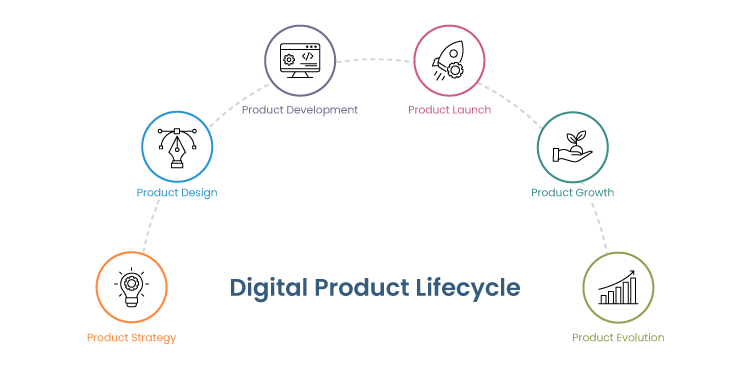
Let us look at the different stages of a digital product lifecycle:

  1. Product Strategy
  2. Product Design
  3. Product Development
  4. Product Launch
  5. Product Growth
  6. Product Evolution

end-to-end-guide

Product Strategy

Product strategy is the plan or roadmap that guides the development, positioning, and marketing of a product or service. It outlines the mission, vision, and goals.

Product owners define the product’s concept, conduct market research, evaluate the competition, and identify customer needs. They create a business based on the insights gained from the research.

The owners create a product concept that outlines the product’s-

  • purpose
  • value proposition
  • target audience, and 
  • potential benefits.

The owners also evaluate the technical, financial, and resource constraints to assess the feasibility of the product.

Outcomes of this phase-

  • User persona- includes identifying user interests, concerns, needs, and goals. 
  • Competitive analysis- identify competitors, market trends, strengths, weaknesses, opportunities, and threats.
  • Value proposition- How a product solves users’ needs and improves their lives. 
  • Product Strategy Canvas- Provide a 360-degree view of the product and business, defining the business model and pricing. 
  • Product OKRs- Establishing a set of objectives and key results to track progress.

Product Design

The product design stage involves creating a blueprint or prototype for the digital product. Designers, development teams, and product owners work together to create a user interface (UI) and user experience (UX) design.

They design the product’s layout, navigation, functionality, and visual elements. The design should align with the product strategy and meet the target audience’s needs.

Digital product design involves three elements: System, interface, and process.

  • System Design

System design involves organizing and preparing a solution that the design offers before considering how the product will look. Create a roadmap outlining how your digital product will function to address the pain points of your target audience.

  • Interface Design

Layout, typography, color scheme, icons, buttons, and other graphical components are used in interface design. These elements visually represent the features and functionalities of the product. Customers define the quality of the product based on the interface design. A well-designed interface delivers a better user experience.

  • Process Design

Process design involves identifying how a user uses the product to achieve the desired result. Product owners balance company and customer needs in this process.

Outcomes of this phase-

  • A list of required resources 
  • Story Sitemap
  • Working prototype
  • Product execution roadmap for developing Minimal Marketable Product (MMP)
  • MMP wire frames
  • Product design style guide

Product Development

The product development stage involves building the product based on the design and specifications developed in the previous phase. 

Developers typically follow an agile approach to build the product rapidly. It involves breaking down the development process into smaller sprints. 

The teams develop specific features or functionalities in each sprint that lasts two to four weeks.

The development stage involves several key steps, including:

  • Writing the code for the product’s features and functionalities
  • Testing the code to ensure desired quality standards
  • Integrating various components of the digital product for seamless operations. 
  • Deploying the product in a test environment.
  • Testing the product with a group of users
  • Identifying and fixing any bugs or issues 
  • Refining the product based on user feedback.

Product Launch

After testing the product, the next step is to launch. There can be two ways to launch the product.

  • Releasing the product features in one go and
  • Releasing the product features in stages.

Launch in stages involves rolling out the features in phases after improvements. Strategies for the product t launch:

  • Soft Launch – Launching the MVP for a small group of early adopters within the target market.
  • Hard Launch – Launching the MVP for the general market with a 
  • Comprehensive marketing campaign.
  • Dark Launch New features are introduced to a specific percentage of users to observe their response to an already-launched product.

The launch phase also involves creating a marketing strategy and advertising campaign to promote the product. The launch should be well executed if you want instant customer interest in the product. It will help boost sales and achieve growth.

Product Growth

Product Growth is the stage where a company can reap the rewards of the product. The user base increases during this phase, leading to higher sales and profitability.

The growth phase determines the long-term success of the digital product. Product owners focus on user acquisition, retention, and monetization during this stage. The aim is to establish the product as a market leader and position it for continued success in the future.

Product Evolution

The product evolution stage involves improving the product while adding new features. There is a constant need to improve and update the products to stay competitive and relevant in the market. Product owners update the products with the latest technologies. These efforts help them stay ahead of the competition, improve efficiency, and surge profits.

Modernization of applications has many approaches, including rehosting, refactoring, re-architecting, or replacing legacy apps for improved efficiency and user experience.

Digital product lifecycle management Best practices

Companies can gain many advantages from an efficient digital product lifecycle management (PLM) strategy. The product lifecycle management 

includes planning and managing each stage– development, growth, marketing, evolution, etc. 

Product success is assured if the product life cycle is well-planned and executed. Consider these best practices to gain the most value from the digital PLM process:

Clearly define product strategy

Defining a clear product strategy that aligns with business goals, customer needs, and market trends is always beneficial. It is a guiding factor in the product development lifecycle to keep it relevant to market demands. Listing the goals and objectives helps the product team identify the tasks needing priority.

Update product strategy

When you created the product strategy, the market demands were different. Technology and customer demands change with time; thus, you also need to update your product strategy. If you update your product based on the current technologies and demands, you will retain the customers, and the product will succeed.

Look at the steps to keep your product strategy updated and aligned with the latest trends:

  • Keep a close eye on industry & technology trends and competitor activity. 
  • Analyze customer feedback to identify areas for improvement.
  • Research the market regularly to identify new opportunities
  • Review and analyze product metrics such as user engagement, retention rates, and customer satisfaction.

Select and train professionals

Train employees on how to use products to reap maximum benefits. Also, educate them on how the product is unique from the rest. 

An increased understanding of the product’s purpose and benefits will enable employees to build the product accordingly. It also improves efficiency and gives better control over the entire development process.

How can UCS help with Digital Product lifecycle Optimization?

Digital product lifecycle management requires a deep understanding of the market needs, technologies, and customer demands. Product owners and developers must plan well and use the right resources for the desired results in each product lifecycle stage. Business owners can partner with a reliable product development company for professional support.

Upsquare Consulting Services offers digital product engineering services to support businesses throughout the product life cycle, from conception to delivery and evolution.

We have expertise that spans 12 years with the broad knowledge to plan your product development life cycle efficiently. We ensure that the products developed are scalable, secure, dependable, and resilient. We ensure that the product is sustainable and profitable. Contact us now to book a free consultation.

How to Start Your Generative AI Journey: Tips and Tricks for Enterprises

Quick Summary

According to Statista, the market size in the generative AI market is projected to reach US$44.89 billion in 2023 and US$207.00 billion by 2030, with the largest market size in the United States (US$16.14 billion in 2023).

Generative AI is a branch of artificial intelligence that can create novel and realistic content, such as images, video, music, speech, text, software code and product designs, based on existing data. Generative AI has many potential benefits and use cases for enterprises, such as faster product development, enhanced customer experience, improved employee productivity, and innovation in various fields. However, generative AI also poses some challenges and risks, such as data quality, ethical issues, legal implications, and social impact.

In this blog post, I will share some tips on how enterprises can start their generative AI journey, what kind of investment and skills they need, and how they can leverage APIs, cloud services, and the open source ecosystem to ease their adoption.

  1. Define your business goals and use cases. Before you dive into generative AI, you need to have a clear vision of what you want to achieve and how generative AI can help you. For example, do you want to generate new content for marketing, customer service, or education? Do you want to design new products, materials, or drugs? Do you want to optimize existing processes, systems, or models? You also need to identify the key performance indicators (KPIs) and metrics that will measure the success and impact of your generative AI projects.
  2. Start with a specific domain. Instead of trying to revolutionize everything at once, pick one domain where things get bogged down in routine tasks. It could be answering the same customer questions again and again, or churning out endless social media posts. This is where Generative AI, your new digital buddy, shines. It tackles those tedious jobs, freeing up your team to focus on the juicy stuff. Think of it like adding a super-productive robot to your squad! Start small, like with an internal project or a pilot run. This lets everyone get comfortable with AI, learn how it works, and fine-tune its outputs. And before you know it, you’ll watch your team soar with more time, energy, and creative spark. Give Generative AI a try, one bite at a time, and watch your business blossom.
  3. Assess your data availability and quality. Generative AI relies on large amounts of data to train and fine-tune the models. You need to ensure that you have access to relevant, reliable, and diverse data sources that can support your use cases. You also need to ensure that your data is well-labeled, cleaned, and curated to avoid bias, noise, and errors. Data refined with your organization’s specific goals will help leverage the best results from Generative AI. You may need to use data augmentation, synthetic data, or data scraping techniques to enrich your data. You also need to comply with the data privacy and security regulations and standards in your industry and region.
  4. Choose the right generative AI models and tools. Depending on your use cases and data, you may need to use different types of generative AI models and techniques, such as foundation models, which are large-scale machine learning models that can be fine-tuned for different tasks and domains, and generative adversarial networks, which are composed of two competing models that learn from each other. You also need to choose the right tools and platforms to build, train, deploy, and manage your generative AI models. You can use APIs, cloud services, and open source frameworks and libraries to simplify and accelerate your generative AI development. For example, you can use Google Cloud’s Vertex AI to access, customize, and embed foundation models into your applications, or use Microsoft Azure’s Cognitive Services to generate content for various scenarios.
  5. Test and validate your generative AI outputs. Generative AI can produce amazing and surprising results, but it can also produce inaccurate, inappropriate, or harmful outputs. You need to test and validate your generative AI outputs before you use them in your business applications. You need to ensure that your outputs are accurate, relevant, and consistent with your goals and expectations. You also need to ensure that your outputs are safe, ethical, and respectful of the intellectual property, privacy, and dignity of the data sources and the content consumers. You may need to use human-in-the-loop, explainability, and feedback mechanisms to monitor and improve your generative AI outputs.
  6. Invest in generative AI skills and culture. Generative AI requires a combination of technical, business, and creative skills. You need to invest in training and hiring talent that can work with generative AI models and tools, as well as understand the business and user needs and preferences. You also need to foster a culture of innovation, collaboration, and responsibility among your generative AI teams and stakeholders. You need to encourage experimentation, learning, and sharing of best practices and lessons learned. You also need to establish clear guidelines, policies, and governance for the ethical and responsible use of generative AI in your organization.
  7. Be Responsible. Technology is a great servant but a terrible master. Before you unleash the power of generative AI, make sure it plays nice! Prioritize ethical practices that address fairness, transparency, and accountability. Foster open communication, too, so everyone understands how this exciting technology works and its potential impact.

Generative AI is not a magic bullet, but a powerful tool that can augment and assist human creativity and intelligence. Generative AI can help enterprises solve problems, generate ideas, and create value in new ways, but it also requires human validation, guidance, and collaboration to ensure its effectiveness and appropriateness. By following these tips, you can start your generative AI journey with confidence and success.

Intrigued by the AI whisper? Upsquare is your friendly AI navigator, ready to chart a personalized course into this game-changing future. Let’s dive deeper into the possibilities and uncover how generative AI can become your personalized launchpad for success. Contact us today and let’s chart your unique course into this transformative era.

Engagement models that help you fulfill your Digital Ambitions and Accelerates Your Possible

Quick Summary

Once upon a time, in the kingdom of CodeTopia, the wise and ambitious King Debugicus decided to outsource the development of a grand software project to a neighboring kingdom known for its coding wizards. Excitement filled the air as the kingdom eagerly anticipated the arrival of the promised technological marvel.

The king, however, made a fateful decision – he chose the “Crystal Ball Engagement Model.” In this model, the developers were expected to predict the future requirements of the software using a magical crystal ball. The king believed that the crystal ball, enchanted by the kingdom’s most skilled wizards, would reveal all the features and changes needed for the software.

As the project kicked off, the developers peered into the crystal ball, hoping for divine insights into the project’s future. To their dismay, the crystal ball showed only vague images and cryptic symbols, leaving the developers scratching their heads.

The first milestone approached, and the developers presented their work to the king. To everyone’s surprise, the software bore little resemblance to the kingdom’s expectations. The crystal ball had failed to provide clear specifications, resulting in a product that seemed more like a magical mishmash than a coherent software solution.

King Debugicus, now facing an angry mob of users and court jesters who couldn’t make sense of the software, realized the error in his engagement model choice.

The Learning:

For a smart customer with high expectations, hoping for magical outcomes and harboring ambitious dreams is natural. However, as a dedicated technology partner-supplier, the responsibility is to guide them towards the most suitable models and choices rather than engaging in fanciful endeavors that lead both parties off track.

How to finalize your engagement model:

One must carefully think through the following questions before making any decisions on choosing the engagement model with your software outsourcing services provider:

  1. What is the stage of your project – Ideation, Feasibility Research, Development, Enhancements, Testing OR Maintenance?
  2. How pressed is this requirement, do you need a quick fix or want to see long term needs being fulfilled?
  3. Do you have inhouse team? Do you need co-creation or complete outsourcing?
  4. Do you have a clear stand on what the budgets look like? Professionals come from different levels of expertise and experience. This is directly proportional to the budgets.
  5. In-house Project Manager/Product Manager is always preferable; do you have one in-house, or does the vendor have to provide one?

At Upsquare, we have a long experience working with many international clients and hence we ensure commitment, dedication, and daring to all the standard engagement models on which the world operates. We nurture the idea/project of the client till it gets converted into a giant blossoming tree.

Upsquare Offers: Engagement models relevant for you in 2024

1. Fixed-price Model

When a clearly documented scope of work is signed and approved at both ends, this is the way to go. Here, the cost and scope of a project and the timeline are agreed upon in advance.

What’s the Upsquare’s Edge in this model – Upsquare helps its customers draft and convert their functional requirements to actual technical specifications. The strategic consulting arm of Upsquare leads this effort. Hence, it provides certainty of budget and time for the client, and Upsquare also provides limited flexibility for changes during the journey.

2. Dedicated Team Model

The Dedicated Team Model is an outsourcing arrangement where a specialized team of professionals works exclusively on a specific project for a minimum engagement of 6 months. Key characteristics of this model is Dedicated availability of experts, easy scalability, long term continuity & knowledge retention. In most cases, the technology provider is responsible for solution delivery, so this is an extension of your team.

What’s the Upsquare’s Edge in this model? Upsquare provides a subject matter expert and domain expert project coordinator who translates clients’ visions and requirements into scrums and manages the standards and quality of deliverables.

3. Milestone-Based / SLA Driven Model

The Milestone-Based Model is a project engagement approach designed for clarity and structured progress. This model establishes specific milestones or checkpoints to mark significant stages in the project. It’s well-suited for process-oriented setups where each step needs to be clearly defined and achieved.

Upsquare’s Edge in this model lies in providing appropriate and detailed process documentation of the project and providing experts who can create, enhance or adhere to the processes associated with the customer requirements.

4. Hybrid (Onsite-Offshore) Model

This model is a collaborative outsourcing approach that combines the strengths of both onshore and offshore teams to optimize efficiency and cost-effectiveness. Key features include Cost Optimization, Access to a Global Talent Pool, 24/7 Availability, Flexibility and Scalability, and Risk Mitigation.

Upsquare’s edge lies in co-investing for onsite establishment, by means of JV, Partnership or quick deployment of resources, thus significantly increasing the chances of success for Hybrid Model.

5. Managed Services model

The Managed Services engagement model offers a comprehensive solution to manage and deliver a defined set of services for a client. It stands out for its emphasis on proactive support, ensuring that the client’s IT infrastructure, applications, and business operations run smoothly. This model typically includes continuous monitoring, maintenance, and support, with the provider taking charge of day-to-day operations, issue resolution, and performance optimization.

Upsquare’s edge lies in providing the resources in the preferred time zone of the client to ensure excellent coordination and perfect process adherence for the projects.

6. High & Low Touch Onboarding Model

In this model, the implementation team takes a hands-on and highly engaged approach, providing comprehensive training and guidance to configure the SaaS solutions effectively. High-touch onboarding processes go further by assigning a dedicated Customer Manager or Account Manager.

Low-Touch Onboarding is particularly well-suited for straightforward software, tools, or plugins, where minimal assistance or configuration is needed for clients to start using the program effectively. Ideal for products with streamlined functionalities, many of these can be directly purchased through an automated sales process.

Upsquare’s Edge lies in being an expert for hiring, training and deploying a team with sufficient experience and knowledge from the Product/SaaS industry along with natural inclination for customer satisfaction.

Call for Action:

In conclusion, selecting the right engagement model for your software outsourcing services is pivotal to your projects’ success and your clients’ satisfaction. It’s essential to align your choice with the complexity and nature of each project, ensuring a harmonious balance between client expectations, project requirements, and resource optimization.

Upsquare’s edge lies in being more than just a service provider – we’re your reliable partner. We deeply understand the significance of three pivotal elements: acquiring the right skills, ensuring swift scalability, and managing within budget constraints. Your success is our priority, and at Upsquare, we bring a personalized touch to every collaboration, ensuring a seamless journey towards accelerating your possible.

Take the wise step and reach out to us to discuss your project requirements.

A Short Guide to Digital Transformation

Introduction

The digital era has thrust organizations into a paradigm shift, where technological adaptation isn’t a luxury but a necessity. Digital Transformation, often abbreviated as DX, integrates digital technology into every facet of the business, leading to profound changes in how businesses operate and deliver value to their customers. But how does one navigate this intricate journey? Let’s dive in.

1. Digital Transformation Best Practices

To ensure a smooth and effective DX, consider the following practices:

a. Clear Vision & Leadership: Set a vision for the transformation journey and ensure top management is onboard.

b. Customer-Centricity: Design your transformation around the customer. Prioritize technologies and processes that enhance customer experience.

c. Empower Employees: Upskill and reskill your workforce. Provide necessary tools and training for the digital age.

d. Data-Driven Decision Making: Harness the power of analytics and big data to inform decisions.

e. Iterative Approach: Use agile methodologies, aiming for continuous improvement rather than a perfect end-state.

f. Cybersecurity: Ensure robust security measures are in place. As businesses become more digital, they’re also more vulnerable.

2. Fundamental Principles of Digital Transformation

  • Adaptability: Be ready to pivot strategies based on new information or changing circumstances.
  • Integration: Seamless integration of technologies is key. Avoid silos which can stifle innovation.
  • Sustainability: Ensure that new processes and technologies are sustainable in the long run.
  • Collaboration: Encourage cross-functional team collaborations. The best solutions often emerge from diverse input.

3. Key Concepts of Digital Transformation

  • Cloud Computing: Utilizing cloud resources to store, manage, and process data.
  • Internet of Things (IoT): Devices connected over the internet, collecting and sharing data.
  • Artificial Intelligence (AI) & Machine Learning (ML): Algorithms and models that allow machines to perform tasks without explicit instructions.
  • Blockchain: A decentralized ledger for recording transactions, best known for supporting cryptocurrencies.
  • Augmented Reality (AR) & Virtual Reality (VR): Technologies that merge the digital and physical worlds.

4. Pros and Cons

Pros:

  • Increased Efficiency: Automation of manual tasks leads to significant time and cost savings.
  • Enhanced Customer Experience: Personalized services and seamless interactions lead to higher customer satisfaction.
  • Informed Decision-Making: Real-time data analytics offers deep insights into business operations.
  • Competitive Advantage: Businesses that adapt quickly often outpace competitors in the market.

Cons:

  • Initial Investment: The upfront cost for technology and training can be steep.
  • Implementation Challenges: Resistance from employees, technical issues, and more.
  • Security Risks: With more data online, there’s a higher risk of breaches.
  • Redundancy: Rapid technological advancements may render some innovations obsolete quickly.

5. The Futuristic View

The trajectory of DX is poised to be even more revolutionary. As quantum computing emerges, AI becomes more sophisticated, and the metaverse begins to shape our reality, businesses must anticipate the changes these developments will bring. Continuous learning, agility, and a focus on ethics will be paramount.

Conclusion

In conclusion, the journey of Digital Transformation, though challenging, is a necessary evolution in today’s business landscape. By understanding its principles, concepts, and intricacies, businesses can position themselves at the forefront of innovation and success.